Earth Observation in Support of European Defence and Security
- Defence Industry
Kacia Rutkoŭskaja
- 0
- 13 minutes read
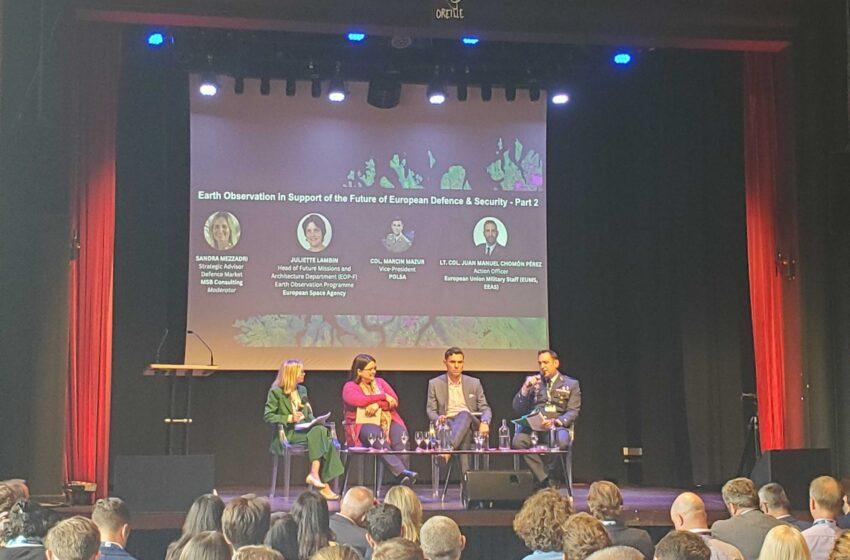
As the geopolitical landscape in Europe and beyond continues to shift, the role of Earth Observation (EO) in supporting defence and security is receiving increasing institutional attention. At EXPANDEO 2026, EARSC’s annual conference for the European EO community, two consecutive panels explored this topic in depth: the first examining the high-level policy and institutional landscape, the second focusing on operational requirements, capability development and future implementation.
A changed security environment
Both panels opened against a backdrop of heightened urgency. Speakers pointed to ongoing instability stemming from the war in Ukraine, tensions in the Middle East, hybrid threats on European territory, rising global competition and a shifting US posture towards Europe. In this context, space-based EO was described as having moved from a primarily civilian and environmental capability to a core component of European security and defence.
The domains where EO is now considered critical were outlined as intelligence, surveillance and reconnaissance, situational awareness, crisis response, infrastructure protection and maritime domain awareness.
One speaker illustrated the operational stakes with a personal account from maritime patrol missions in the Horn of Africa and off the Libyan coast, noting that insufficient satellite revisit times and data latency had resulted in aircraft arriving at areas of interest only to find no activity, burning fuel, exhausting crews and wasting flight hours. Persistence, responsiveness and faster data delivery were identified as areas where the technology still needs to be developed to meet operational needs.
The EU institutional landscape
The first panel provided an overview of the main EU-level programmes and institutions active in the EO for defence space, and how they relate to one another.
At the European Commission level, a number of programmes are currently relevant to the EO industry. The European Defence Fund (EDF) has included space as a category of action since its inception, with projects such as SPIDER, now entering its second phase, among the notable funded activities. Two further EDF projects focused on EO and signal degradation from space were noted as recently awarded.
The European Defence Industry Programme (EDIP) was presented as a framework supporting industrial reinforcement and common procurement actions aimed at strengthening European defence industrial capacity. It includes a procurement call specifically targeting sensors and EO-related elements, with publication expected shortly after the conference.
The SAFE initiative provides loans to member states, including for the procurement of defence equipment in which space systems feature.
A new scheme called Agile, successor to EUDIS, was described as a fast-track procurement pathway for startups and high-TRL companies, aiming to reduce the time from proposal to grant to four months with budgets of approximately four to five million euros per project.
The European Defence Agency was described as an intergovernmental body reporting to the 27 EU ministers of defence, working on capability development through a structured process of common staff targets and common staff requirements across space subdomains including EO, positioning, navigation and timing, satellite communications and space situational awareness.
The Defence and Space Forum was described as the coordination venue for the defence dimension of space, bringing together member states, the Commission, EU military staff, EUSPA and SatCen, with NATO participating on dedicated agenda items.
The EU Satellite Centre was described as a joint agency providing geospatial intelligence in support of EU’s foreign and security policy. Speakers noted that SatCen does not own or operate satellites, but transforms satellite imagery and collateral data into timely, user-driven analytical products. More than 90% of the data used is commercial, with over 80% by value sourced from European providers. SatCen was described as contributing to the EOGS process by anchoring it in real operational requirements and bringing the full user chain, from tasking through to dissemination and decision-making, into the system design.
The EU Military Staff was described as contributing to capability development through coordination with EDA, and to mission planning through the Military Planning and Capability Centre. A dedicated space cell is being established within the MPCC to proactively integrate space capabilities and EO data products into EU missions and operations, replacing what was described as a previously reactive approach.
Dual use: an unresolved question
A significant portion of the first panel was given over to the question of dual use, with speakers offering different perspectives on its meaning and implications.
One participant argued that the term is undefined in EU legislation, that different actors apply it differently, and that this ambiguity creates practical and legal risks. Under the banner of dual use, it was noted, civilian institutions can seek defence funding on the basis that their systems serve military purposes, while defence actors can lean on civilian infrastructure. This raises questions around data security, governance, liability and whether repurposing a civilian asset for military use makes it a legitimate military target. A capability-based framework was proposed to distinguish between systems designed first and foremost for military use that also serve civilians, and civilian systems adapted for military purposes under operational pressure.
Another speaker pushed back, arguing that at the application level, EO capabilities often cannot be simultaneously civilian and military in practice. The Copernicus programme was cited as an example where the civilian mandate prevented its use in a defence context, which in turn prompted the development of a separate governmental service capability. The point was made that defence applications carry specific requirements around data security, secure data flows, military-compliant cloud infrastructure and confidentiality that civilian systems are not necessarily designed to meet, and that the industry needs clarity on this distinction when positioning products and services.
EOGS: the emerging opportunity
The European Observation and Governmental Satellite system (EOGS) was a recurring reference across both panels as the central near-term opportunity for the EO industry.
Speakers described EOGS as a progressive effort to move from current fragmented capabilities to a structured European governmental EO service, not replacing what exists, but reinforcing it, reducing dependencies and ensuring trusted access to secure and timely data. The initiative is being shaped through a collaboration between the European Commission, ESA and EDA, with SatCen contributing operational requirements and the user chain perspective.
ESA’s European Resilience from Space (ERS) programme was described as directly connected to EOGS preparation. Element 1 of ERS is focused on defining the end-to-end architecture of EOGS and identifying gaps in current European capability, with architecture studies and an end-to-end simulator already in procurement. In-orbit demonstration and validation activities have been launched with a requirement to demonstrate results by the end of 2028, ahead of the next Multiannual Financial Framework. Phase AB space and ground segment definition studies are also planned.
Element 2 of the ERS programme is more tailored to individual member state needs, supporting the development of sovereign space components and downstream processing capabilities in clusters of interested countries, with interoperability built in from the start.
The key questions the architecture work is intended to answer include what Europe already has and how it can be pooled and shared, where the gaps are, in terms of local time coverage, night vision or other capabilities, and how to optimise existing assets before procuring new ones. Speakers expressed confidence that the architecture studies, demonstrations and validation activities underway could ensure readiness for EOGS implementation when the new MFF begins.
National programmes and pooling and sharing
Poland was cited as a case study in the relationship between national capability development and European coordination. Speakers described an active effort to align the Polish Ministry of Defence’s requirements with the Polish Space Agency’s development activities, with the goal of building interoperable ground and user segments that can feed into broader European data-sharing arrangements.
The potential of national constellations to contribute to European-level data access was highlighted, particularly in crisis management contexts where openly distributable commercial data complements more restricted governmental sources.
The tension between pooling and sharing on one hand and national sovereignty on the other was raised as a persistent challenge. The EU SATCOM Market project was referenced as a successful precedent for a structured arrangement in which industry provides services against defined governmental requirements. Speakers suggested that a well-designed hub for image pooling and sharing, with clear differentiation between what is provided by national, governmental and commercial capabilities, could work on similar principles.
Emerging technologies and the road ahead
Artificial intelligence was identified as an important enabler for absorbing and fusing the large volumes of data generated across EO and other sensor domains, with speakers pointing to its potential to support faster decision-making in operational settings. Data security against cyber attack, secure dissemination pipelines and sustainable service continuity were also highlighted as technology priorities.
Looking ahead two to three years, speakers described a realistic near-term goal as demonstrating what pooling and sharing of existing European assets can deliver in practice, using the architecture simulator and proof-of-concept work underway to test options before committing to major new infrastructure.
Proliferated commercial constellations were seen as a growing resource, provided governance frameworks develop alongside them to ensure they can be integrated into defence and security use cases with the necessary security and trust requirements met.
For industry, the message across both panels was consistent: the current moment, with EOGS in preparation, ERS activities underway, EDIP procurement calls opening and the Agile scheme being established, represents a period of active opportunity. Engagement pathways mentioned included EDF and EDIP information days, national armaments directorates and national defence industry associations for EDA-related capability work, SatCen’s European Industry Days, and direct participation in ESA ITTs.
A domain in transition
As only the second year that EXPANDEO has included a dedicated security and defence session, expanded from one to two panels due to audience interest, the discussion reflected a sector in transition. EO, long positioned as a civilian and environmental capability, is now being discussed in explicitly operational terms, with EU institutions actively designing the frameworks, programmes and governance structures that will shape how the industry engages with defence and security requirements in the years ahead.
Photo credit: EARSC LinkedIn