Unlocking the power of Earth Observation for the Ocean
- Earth Industry
Kacia Rutkoŭskaja
- 0
- 9 minutes read
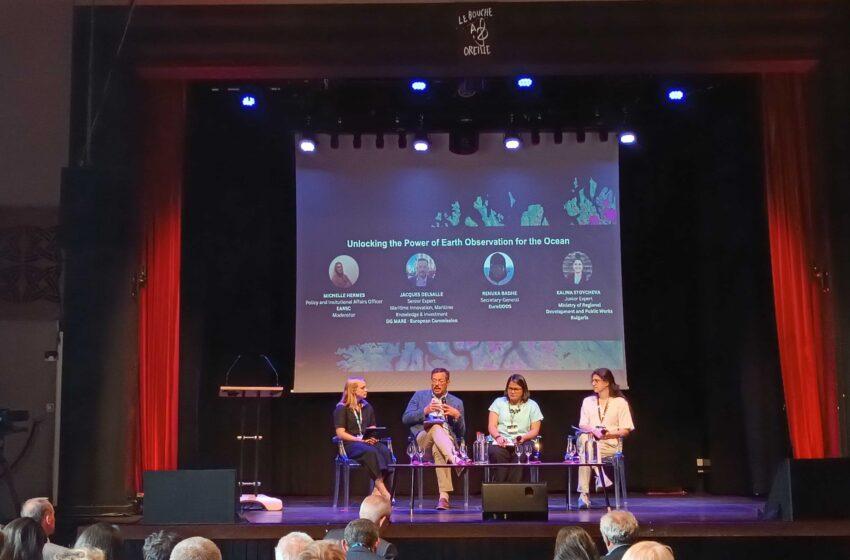
As Europe develops new initiatives related to ocean governance and observation, the role of Earth Observation (EO) in understanding and managing marine environments is receiving growing attention.
This topic was explored during the panel discussion Unlocking the Power of Earth Observation for the Ocean at EXPANDEO 2026, EARSC’s annual conference for the European EO community. Bringing together representatives from European institutions, ocean observation organisations and public authorities, the session examined how EO can contribute to emerging initiatives such as the EU Ocean Pact, OceanEye and the future EU Ocean Act.
Oceans move higher on the European agenda
The discussion took place against a backdrop of significant policy activity around oceans at both European and international levels.
Participants highlighted the EU Ocean Pact, adopted in June 2025 and announced at the UN Ocean Conference in Nice, which aims to provide a coherent framework spanning marine ecosystem protection, blue economy development and the well-being of coastal communities. Alongside it, several related initiatives are taking shape. OceanEye, the EU Ocean Monitoring and Observation Initiative, was published as a formal communication in the week of the conference. Work towards a future EU Ocean Act is expected to follow in 2027, building on the revision of the Maritime Spatial Planning Directive. Other recent milestones mentioned during the session include new EU strategies on ports, industrial maritime affairs, island communities and coastal communities.
Speakers pointed to the broad range of areas where improved ocean knowledge can support decision-making, including marine protection, climate resilience, coastal communities and economic activities linked to the sea.
From Earth Observation to ocean intelligence
One of the central messages of the panel was that understanding the ocean requires more than a single source of information.
While satellite-based Earth Observation provides extensive coverage across large areas, participants emphasised the importance of combining EO data with in-situ observations collected through ships, buoys, underwater sensors and other monitoring systems. Satellite observations offer a broad picture of surface conditions, while in-situ measurements provide calibration, ground-truthing and insight into processes not visible from space. One participant illustrated this point with an example from Southern Ocean research, where satellite imagery was used to guide a vessel toward areas of apparent phytoplankton activity, only for underwater sampling to reveal significant growth at depth that the surface data had not captured.
Speakers described the importance of integrating different sources of information to build a more complete understanding of marine environments, rather than treating satellite and in-situ systems as separate.
Supporting the blue economy
Beyond environmental monitoring, the discussion also touched on the role of ocean observation in supporting economic activities.
Participants noted that better knowledge of marine conditions can contribute to more informed decision-making across sectors such as fisheries, aquaculture and coastal development. Speakers referenced the potential for improved data to support planning processes and help stakeholders better understand risks and opportunities in marine environments. The growing importance of ocean data and digital tools for sustainable maritime activities was also raised, with references to smart fishing and smart aquaculture as areas where better marine knowledge is increasingly relevant.
OceanEye and the future of ocean observation
The recently published OceanEye communication featured prominently throughout the discussion. Participants noted that the initiative had originally been conceived as a mechanism to coordinate in-situ observation across European national authorities. According to the discussion, the initiative evolved beyond its initial conception, and in its current form, it encompasses the full knowledge value chain, from in-situ and satellite observation through to digital systems and end-user applications.
The initiative was described as structured around four pillars. The first focuses on EU governance, aiming to strengthen coherence across observation programmes, funding streams and digital infrastructures, including Copernicus and the European Digital Ocean system. The second addresses the international dimension, with a proposed international alliance open to non-EU countries, international organisations, the private sector and philanthropy, with a planned launch at the UN General Assembly in September. The third targets the development of innovative markets and sectors, particularly through the forthcoming digital twin ocean. The fourth covers broader engagement, including education, culture and public awareness.
Participants noted that OceanEye is a policy communication rather than a funding programme, with budget commitments remaining tied to the next Multi-Annual Financial Framework. The initiative was described as intended to raise awareness, align priorities and mobilise actors across the ocean observation landscape.
Bridging the gap between data and decision-making
An audience poll conducted during the session identified the most commonly cited barriers to wider EO use in ocean-related decision-making as data accessibility and interoperability, insufficient integration into decision-making processes, resource constraints and limited awareness among policymakers.
Participants noted that decision-makers are not always familiar with EO capabilities, and that public authorities often need information that can be integrated into existing systems and workflows. One speaker described a situation in which satellite-derived data and official ministry data showed significantly different results for a mapped river flood area, but the satellite data could not be used as a substitute because it was not formally recognised as a valid source by the relevant authority.
Recommendations from panellists for the EO industry included co-designing systems with users, adopting FAIR data practices, standardising calibration and validation reference networks, and ensuring data can be integrated through open formats and web services. Participants also noted that improving uptake depends as much on communication and user engagement as on technical development.
Investing in future talent
The final part of the discussion focused on skills, awareness and capacity building.
Participants highlighted the importance of helping policymakers and public administrations better understand EO capabilities. Several speakers noted that GIS expertise is limited across many national ministries, and that this contributes to the gap between available data and its use in policy. Speakers also raised the value of engaging students through competitions and hands-on tools, noting that early exposure to EO technologies benefits both future public sector experts and the EO industry itself.
A topic gaining momentum
As the first ocean-focused session at EXPANDEO, the discussion reflected growing interest in the role of Earth Observation within ocean observation and governance. Several speakers pointed to the current period as an important moment for engagement, with OceanEye recently published and work on the future Ocean Act continuing. Ocean-related issues are gaining prominence within the European policy agenda, and participants highlighted ongoing efforts to connect satellite observations, in situ measurements and digital tools in support of a better understanding of Europe’s oceans.
Photo Credit: EARSC LinkedIn