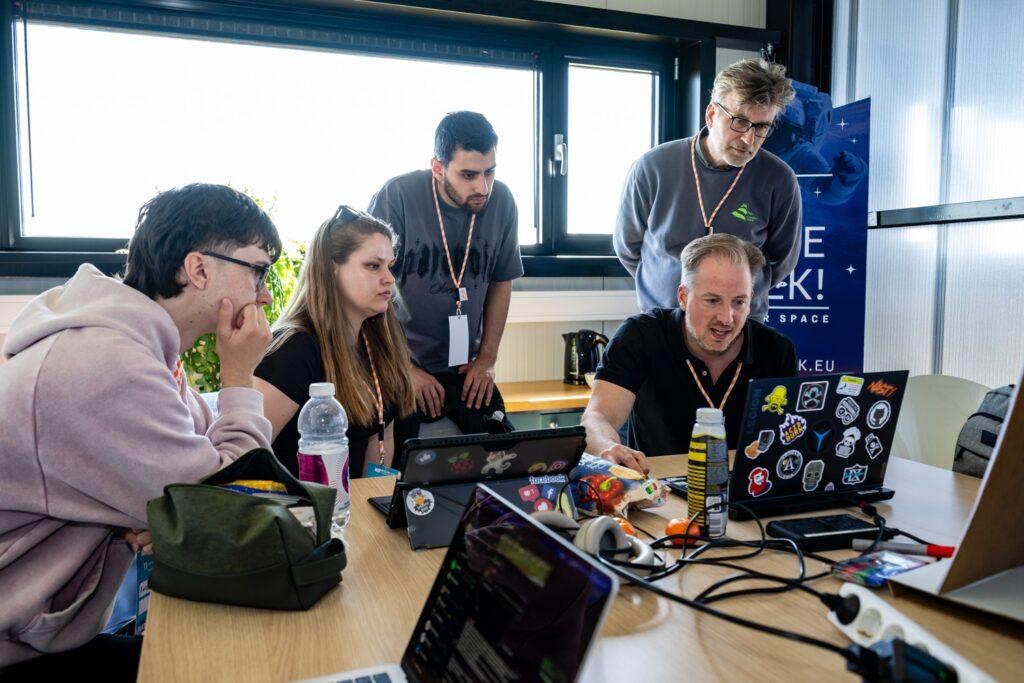
Scaled Autonomy demonstrates the world’s first autonomous FPV interceptor drone at EUDIS Hackathon Netherlands
- Defence HACKATHONS
Vincet Veritas
- 0
- 10 minutes read
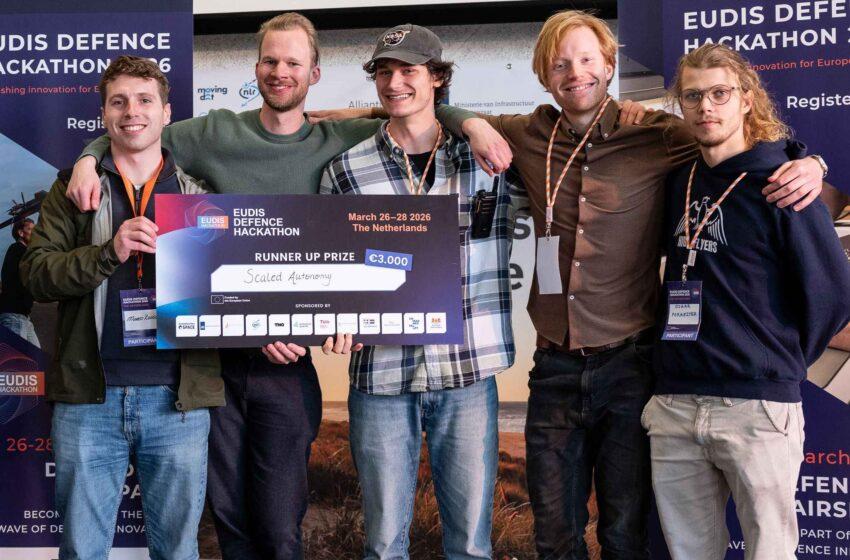
Dutch startup Scaled Autonomy secured second place at the EUDIS Defence Hackathon (Spring 2026) held at Unmanned Valley in Katwijk, the Netherlands, with a fully autonomous interceptor drone specifically designed to counter small FPV drones. The team combines expertise in aerospace engineering, autonomous systems and computer vision to develop scalable counter-drone technology focused on low-cost deployment.
The company was founded by aerospace engineers Marco Xausa, Jesse Hagenaars and Erin Lucassen, and works closely with engineers and researchers from TU Delft. Alongside the startup, Xausa also leads the Delft Drone Initiative, a nonprofit organisation focused on developing drone talent and connecting academic research with practical applications.
The EUDIS Defence Hackathon, supported by the European Commission through the European Defence Fund, brings together teams across Europe to work on defence and security challenges. Participants collaborate intensively over a 48-hour period, followed by a mentorship phase designed to help teams refine and further develop their solutions. The programme connects teams with defence experts, investors and industry stakeholders across Europe.
Bringing autonomous interception systems together in a real-world environment
According to Xausa, the core technological components behind the team’s solution already existed before the event, including the drone platform, control systems and computer vision capabilities. The hackathon provided the opportunity to integrate those components into a complete operational system and test it in practice.
“Our solution consists of several building blocks,” Xausa explains. “What the hackathon gave us was the opportunity to bring all those parts together for the first time and successfully carry out a real interception at Unmanned Valley. That was a significant milestone for us.”
The team’s work focuses on responding to the increasing proliferation of low-cost FPV drones in modern warfare. While large unmanned systems often receive significant public attention, Xausa argues that the challenge posed by mass-produced smaller drones remains less addressed.
“Ukraine alone is producing around four million small FPV drones per year,” he says. “To counter thousands of drones, you need thousands of interceptor drones in return. That makes scalability and cost the central challenges.”
To address this, Scaled Autonomy focuses on developing highly efficient autonomous systems capable of running on relatively inexpensive hardware. The aim is to create interceptor drones that can be deployed at scale while remaining financially sustainable.
“At the hackathon, we showcased what we believe to be the world’s first fully autonomous interceptor drone with all control driven entirely by AI,” Xausa says. “Since then, our software has continued improving week by week.”
Building practical aerospace systems with accessible technology
Xausa describes drones as a major shift in accessibility within aerospace technology.
“For the first time, aerospace-grade capability became accessible to anyone,” he explains. “You no longer need hundreds of millions to build something meaningful. For a few hundred euros, anyone can build a drone and start developing on it.”
At the same time, the accessibility of these systems has changed the security landscape, creating demand for scalable countermeasures that can operate at similar cost levels.
The Scaled Autonomy team consists primarily of engineers and researchers from TU Delft, including several PhDs in drones and AI. According to Xausa, maintaining a strong technical foundation has been central to the project from the beginning.
The company first became involved in defence-focused hackathons during an earlier event in Amsterdam approximately one year ago. Since then, the team has continued expanding both technically and organisationally.
Growing a broader drone innovation ecosystem
Alongside the commercial activities of Scaled Autonomy, the Delft Drone Initiative plays a parallel role in developing technical talent and connecting students with industry-relevant projects.
The Initiative organises drone-building workshops, provides access to testing infrastructure, and supports students and early-stage teams interested in drone technology. During the EUDIS Hackathon, the Initiative brought a group of 18 participants to the event, where they worked on various drone-related concepts and collaborations.
“What we try to do is make drone technology as approachable as possible,” Xausa explains. “Students take their drone home at the end of workshops so the learning continues beyond the event itself.”
Reflecting on the broader importance of community-building, Xausa emphasises the role of people rather than individual ideas alone.
“It’s all about the people,” he says. “Ideas are just ideas, and ideas change — but it’s the people who come up with the solutions and execute on them.”
Hackathons as focused development environments
For Scaled Autonomy, the EUDIS Hackathon served not only as a competition but also as a highly focused development sprint.
“For us specifically, the hackathon was a perfect opportunity to get the whole team in one place, focus on a single goal, and work intensively for three days straight,” Xausa says. “Even for a more mature startup, that kind of focused sprint has real value.”
The team also highlighted the importance of having suitable testing infrastructure available during the event, particularly for drone-based systems that require real-world flight testing.
“The testing infrastructure at Unmanned Valley was genuinely great,” Xausa says. “Having both indoor and outdoor facilities available during the event is essential when you’re working with drones.”
Looking at the broader evolution of hackathons, Xausa notes that these events increasingly serve as meeting points between startups, researchers, industry and government stakeholders.
“The hackathon format has clearly matured beyond its origins as a fun weekend of coding,” he says. “It’s increasingly becoming a meeting point between sectors, with real technology being tested and real partnerships forming.”
Next steps for Scaled Autonomy
Following the EUDIS Hackathon, Scaled Autonomy is preparing for an investment round aimed at scaling its technology across Europe and continues developing its autonomous interception systems. The company is currently exploring further collaborations within the European defence ecosystem, and rapidly expanding the team for both commercial and engineer positions.
At the same time, the Delft Drone Initiative continues expanding its educational and community activities, with the aim of supporting the development of future drone engineers and operators in the Netherlands.
The team is currently open to internships and collaboration opportunities for students, engineers and researchers interested in autonomous drone systems and aerospace technology.
Bringing people, ideas, sectors and technology together through hackathons
Hackathons like EUDIS continue to demonstrate how collaborative formats can support the development of practical solutions to emerging technological and security challenges. At dotSPACE Foundation, hackathons regularly bring together participants from academia, startups, industry and public institutions to work on topics including defence, climate, agriculture, water and digital technologies.
Beyond technical development, these events also create opportunities for knowledge exchange, testing, networking and long-term collaboration between sectors that do not always naturally interact.
Photo credits by Monica Stuurop & Marjolein Vinkenoog