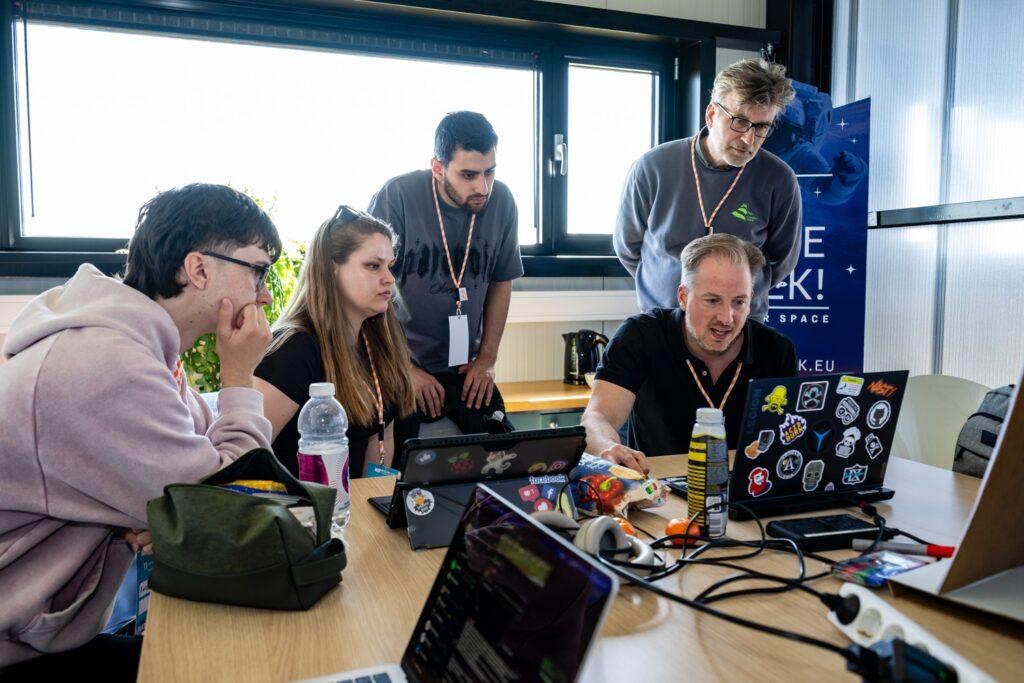
SmallSat Europe 2026 reflects the evolving role of small satellites in Europe’s space sector
- Industry Technology
Kacia Rutkoŭskaja
- 0
- 5 minutes read

SmallSat Europe returned to Amsterdam from 26 to 28 May for its second edition. Organised by SatNews Events, the conference featured an expanded exhibition and conference programme, with discussions spanning business, defence and technical developments across the small satellite sector.
While the event remains focused on small satellites, discussions throughout the three days reflected developments that extend well beyond spacecraft platforms themselves. Business strategy, defence applications, industrial capacity, connectivity and artificial intelligence featured prominently across the programme, highlighting the increasingly central role of small satellites within the wider space economy.
A growing forum for the European small satellite community
The 2026 edition built on the foundations established during the inaugural event in 2025. Alongside a larger exhibition floor, the conference programme expanded to include dedicated business, defence and technical tracks, reflecting the diversity of organisations active across the sector.
The exhibition featured satellite manufacturers, subsystem suppliers, launch providers, software companies, investors, institutional organisations and research actors. Formal presentations were complemented by business meetings, networking sessions and discussions taking place across the exhibition floor.
The growing scale of the event mirrors broader activity across the European small satellite market, where commercial operators, public institutions and emerging companies are increasingly working across shared technical and operational challenges.
From technology development to operational deployment
A recurring theme throughout the conference was the shift from technology development towards implementation and operational scale.
Sessions focused on topics such as satellite manufacturing capacity, supply chain resilience, launch access, constellation deployment and procurement approaches. Rather than discussing future possibilities, many conversations centred on how existing capabilities can be expanded, financed and integrated into operational systems.
Artificial intelligence also appeared throughout the programme, particularly in relation to Earth observation, onboard processing and mission operations. Discussions generally focused on practical deployment and operational reliability rather than experimental applications.
Defence and dual use applications gain visibility
The dedicated defence track reflected the growing role of space technologies within European security and resilience discussions.
Several sessions examined the relationship between commercial and institutional capabilities, alongside topics including Earth observation, communications infrastructure and resilient space architectures. The prominence of these discussions illustrates how defence and dual use considerations are becoming an increasingly visible part of the European space landscape.
At the same time, the conference maintained a strong focus on commercial markets, highlighting the extent to which technical, commercial and policy considerations are becoming more closely interconnected.
A reflection of a changing sector
Perhaps the most notable observation from SmallSat Europe 2026 was the breadth of topics covered under the umbrella of small satellites.
What began as a market segment traditionally associated with lower cost spacecraft and emerging commercial opportunities is now closely linked to discussions about industrial capacity, critical infrastructure, security, connectivity and long term operational resilience.
As a result, the event increasingly serves as a reflection of broader developments across the European space sector, where small satellites continue to play a growing role in commercial services, institutional programmes and strategic initiatives.
If the evolution of the first two editions is any indication, future discussions are likely to continue expanding beyond spacecraft technology alone, reflecting the wider economic, industrial and policy environments in which these systems operate.
Photo Credit: SmallSat Europe