From space research to autonomous defence systems: Estel Industries develops low-cost drone interceptors
- Defence HACKATHONS
Vincet Veritas
- 0
- 9 minutes read

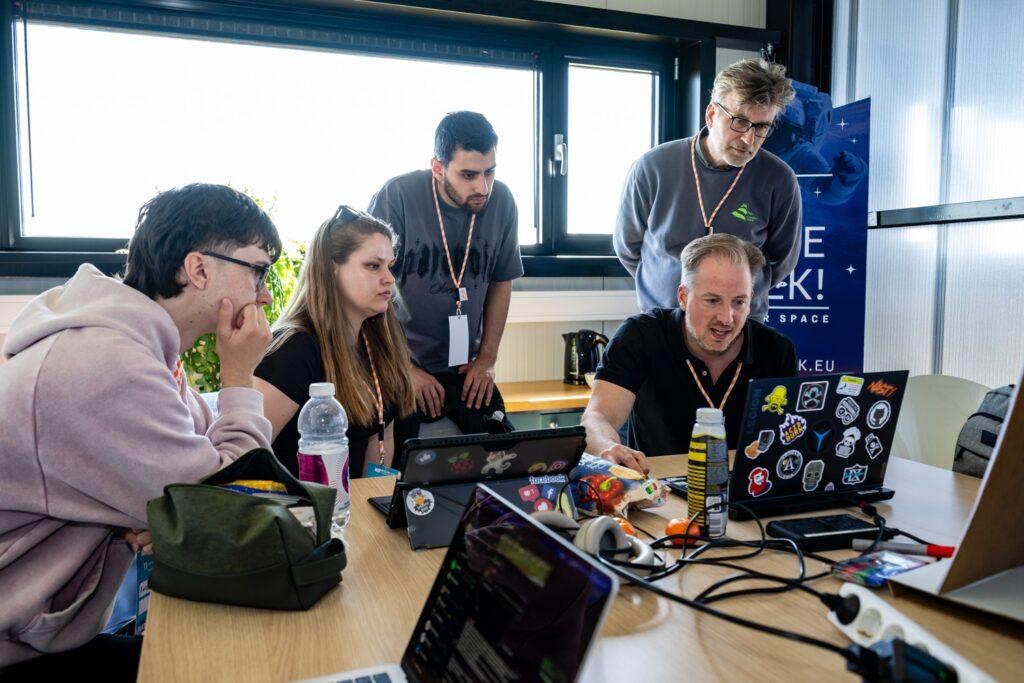
Estel Industries, a newly established Dutch startup developing autonomous interceptor-based counter-drone systems, secured third place at the EUDIS Defence Hackathon (Spring 2026) held at Unmanned Valley in Katwijk, the Netherlands. The team is working on low-cost interceptor systems designed to address the growing challenge posed by mass-produced drones in modern defence and security environments.
The company was founded by Daniel Kogan, whose background combines life sciences, space technology, and automated systems. Before moving into defence technology, Kogan worked on organ-on-a-chip systems and later on automated laboratories for microgravity research aboard the International Space Station through the company SpacePharma.
The shift towards defence technology came as a response to developments in Ukraine and the rapid evolution of low-cost autonomous systems.
“The war in Ukraine had a strong impact on me,” Kogan explains. “The scale of destruction and the rapid evolution of low-cost autonomous systems made me start thinking about scalable defensive technologies.”
The EUDIS Defence Hackathon, supported by the European Commission through the European Defence Fund, brings together teams across Europe to work on defence and security challenges. Participants collaborate intensively over a 48-hour period, followed by a mentorship phase designed to help teams refine and further develop their solutions. The programme connects teams at different stages with defence experts, investors and industry stakeholders.
From life sciences and space research to autonomous defence systems
Kogan’s original idea focused on portable interceptor systems that could be carried by soldiers. However, discussions with Ukrainian contacts shifted the concept towards greater autonomy.
“Initially, the idea was something soldiers could carry, but feedback from Ukrainians quickly shifted that thinking,” he says. “They don’t want to carry anything. They want to be in a bunker controlling automated systems, because defence technologies are becoming increasingly autonomous.”
The result is a fully autonomous counter-drone system intended to intercept low-cost aerial targets using small interceptor systems. The team’s approach focuses on scalability and cost efficiency, reflecting the economics of current drone technologies.
“Current defensive solutions were not made for these low-flying, low-cost challenges, and are financially unsustainable in attrition-based scenarios,” Kogan explains. “To address this challenge, you need even lower-cost, mass-scale autonomous systems.”
The origins of Estel Industries can be traced back to an earlier EUDIS hackathon in Spain, where Kogan and his team developed the first version of the concept and secured second place. Since then, the project has evolved from a part-time initiative into a full-time startup effort with a growing team and several hackathon participations across Europe
Building through hackathons and rapid iteration
For the Estel Industries team, hackathons have become both a development environment and a way to expand their network within the defence ecosystem.
“At the very first hackathon in Spain, the main benefit was getting feedback,” Kogan says. “But at later stages, once you’re actively developing a technology, these hackathons become tremendously useful for making connections with defence organisations, advisers, mentors and other companies.”
The team also uses hackathons to meet potential collaborators and technical talent. According to Kogan, building multidisciplinary teams remains one of the key challenges for early-stage defence startups.
One aspect the team has had to navigate carefully is balancing openness with intellectual property considerations.
“Hackathons are essentially building in public,” he explains. “You can’t demonstrate your most patentable innovations, because presenting them publicly can compromise your ability to patent later. So you have to find a balance between showing meaningful progress and protecting what makes your solution unique.”
At the EUDIS Hackathon in the Netherlands, the team initially planned to build and demonstrate the launcher’s pan-tilt mechanism. However, after learning that live flight tests might be possible at the airfield, priorities shifted towards building a functional launch system instead.
The launch demonstration ultimately could not proceed due to airfield regulations, but the team still viewed the event as a valuable step forward.
“We made valuable connections and placed third,” Kogan says. “We made real progress, and I think our concept ticks all the right boxes for the current era of autonomous systems.”
From a hackathon concept to a formal company
Shortly after the event, the team formally incorporated under the name Estel Industries. The company is now focused on developing operational prototypes, expanding the engineering team, and preparing for testing activities.
“We’re serious about turning this technology into an operational product for defence and security applications,” Kogan says.
According to the team, one of the near-term goals is to conduct testing in operationally relevant environments.
Alongside technical development, Estel Industries is preparing for a seed investment round and is actively seeking aerospace engineers, guidance and navigation specialists, and multidisciplinary technical talent.
The team also recently participated in the European Defence Tech Hackathon in Tilburg, the Netherlands, where they secured first place with the continued development of their autonomous counter-drone concept.
Advice for (future) hackathon participants
Reflecting on his experience across multiple hackathons, Kogan emphasises the importance of rapid validation, structured teamwork, and actively engaging with mentors and participants.
“Use hackathons to validate, build fast, and get real feedback,” he says. “You can make an enormous amount of progress in just a few days. Talk to as many people as possible, but divide the work deliberately within your team. Some people should keep building while others learn and network.”
Bringing people, ideas, sectors and technology together through hackathons
Hackathons like EUDIS continue to demonstrate how collaborative formats can accelerate the development of practical solutions to complex challenges. At dotSPACE Foundation, hackathons regularly bring together participants from academia, industry, government and startups to work on topics ranging from defence and security to climate, agriculture, water and digital technologies.
Beyond the technical work itself, these events also create opportunities for networking, knowledge exchange and cross-sector collaboration, helping teams refine ideas and connect with potential partners, users and investors.
Photo credits by Monica Stuurop & Marjolein Vinkenoog