Open Dataspace Lab Launches as New Environment for Secure Public-Sector Data Sharing
- Open DataSpace Lab Technology
Kacia Rutkoŭskaja
- 0
- 5 minutes read

The Open Dataspace Lab (ODL) is now operational. The platform is hosted by dotSPACE and developed under the leadership of the Netherlands Food and Consumer Product Safety Authority (NVWA) and Rijkswaterstaat (RWS), in collaboration with partners in the Netherlands and throughout Europe. It offers a controlled digital environment where organisations can work with satellite, drone, sensor and sonar data without transferring raw files between organisations. The focus is on producing insights while keeping source data under the owner’s control.
ODL follows a compute-to-data approach. Algorithms run inside the technical environment of the data owner, and only the authorised output is shared. This removes the need to exchange full video recordings, imagery archives or sensor logs. The model aligns with European rules on privacy and data governance and aims to make cooperation between public and research institutions easier to organise.
Technical setup
ODL is built as a decentralised dataspace that supports compute-to-data workflows. Participants use containerised software and run processing steps close to the source. Access policies and digital identities define who can do what. All actions are logged, and a blockchain component records access and usage information for transparency.
The system supports various data types, including drone images, satellite observations and sonar data. Data providers can publish or connect their data and algorithms and other material. The setup follows the principles of Gaia-X thus avoids dependence on a single cloud provider.
European interest
The European Commission invited the NVWA to present ODL at a meeting in Zagreb, last September. Several member states signalled that they face similar challenges when dealing with sensitive operational data. They also expressed interest in solutions that give public authorities more control over their information. These discussions will continue in the coming months as countries explore opportunities for joint pilots.
Who ODL is intended for
ODL is designed for organisations that work with environmental, maritime or geospatial data. This includes government agencies, research institutes, universities, technology companies, start-ups and multi-partner innovation projects. Participants can contribute data, run analyses or collaborate on pilot activities inside the platform.
Testing the platform in Drone2Go
A recent test within the Drone2Go project showed how this works in practice. The Dutch Food and Consumer Product Safety Authority (NVWA) carried out a drone flight over the North Sea to detect illegal fishing. The same flight recorded signs of possible oil pollution. That information would normally be relevant for Rijkswaterstaat, but sharing the entire recording is not always appropriate.
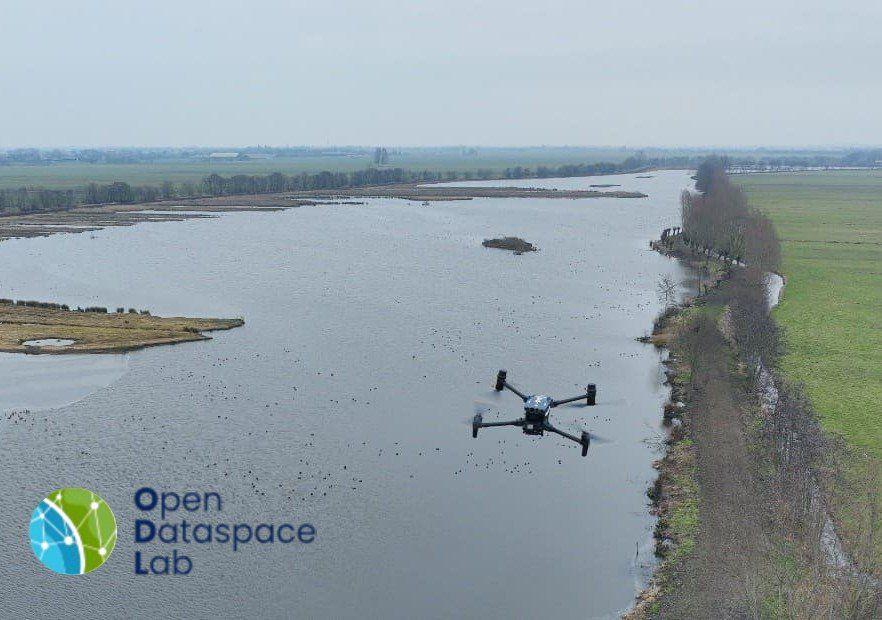
During the test, the NVWA placed the data inside ODL. Rijkswaterstaat assessed the environment and ran an algorithm designed to detect oil contamination. The platform returned only the fragments that fell within RWS’s responsibilities. The NVWA retained the full recording.
The test demonstrated that agencies can exchange information without exchanging the underlying footage and without repeating similar monitoring flights.
How to take part
Organisations interested in trying the platform can contact the ODL team for an introductory session or to set up a small pilot. The platform also offers access to public sample datasets and demonstration workflows.
For more information: info@groundstation.space